Presse-étoupes antidéflagrant
Dans les environnements à risque d’explosion, une entrée de câble correcte n’est pas un détail, mais un élément essentiel de la sécurité globale de l’installation. Les presse-étoupes antidéflagrants assurent une étanchéité fiable, une décharge de traction et une protection mécanique des câbles dans les zones Ex. Chez Ysebaert, vous trouverez une gamme complète de presse-étoupes ATEX et d’accessoires pour de nombreuses applications, avec des versions en laiton nickelé et en plastique, différents types de filetages et des solutions adaptées à diverses sections de câbles. En plus des presse-étoupes, nous proposons également des bouchons Ex, des réductions et des adaptateurs, afin de pouvoir obturer en toute sécurité des entrées inutilisées ou adapter correctement les filetages et perçages existants.
Que vous conceviez une nouvelle installation, assembliez un coffret de raccordement ou étendiez une installation Ex existante, nous vous aidons à sélectionner les composants adaptés pour un montage sûr, conforme et durable. Pour choisir rapidement le bon presse-étoupe Ex, bouchon Ex ou raccord de réduction adapté, vous pouvez compter sur nos conseils techniques et une vue claire des solutions disponibles.
Presse-étoupes antidéflagrants Exd / Exe
Laiton nickelé / plastique / acier inoxydable (inox 316)
Nos presse-étoupes antidéflagrants sont disponibles en laiton nickelé, plastique et acier inoxydable pour un passage de câble sûr dans les zones Ex. Vous pouvez choisir parmi différents types de filetages et plages de serrage afin d’assurer une compatibilité parfaite avec le diamètre du câble et le boîtier. Vous réalisez ainsi une entrée de câble ATEX fiable avec une attention particulière portée à l’étanchéité, à la décharge de traction et à la conformité.
Nous proposons des solutions pour :
- câbles armés et non armés,
- applications EMC,
- filetages métriques et NPT.
Vous ne trouvez pas ce que vous cherchez ? Les options suivantes sont également disponibles sur demande :
- température ambiante -60°C à +140°C,
- autres plages de serrage,
- dimensions jusqu’à M130x2,0 et 5” NPT,
- presse-étoupe pour câble plat,
- autres certifications,
- ...
Bouchons ATEX Exd / Exe
Laiton nickelé / plastique / acier inoxydable (inox 316)
Les bouchons antidéflagrants assurent une fermeture sûre des entrées de câble inutilisées dans les environnements explosibles. Chez Ysebaert, vous trouverez une large gamme de bouchons certifiés ATEX pour applications Ex e et Ex d, disponibles en laiton nickelé, plastique et inox, avec filetages métriques et NPT.
Réductions et adaptateurs ATEX
Laiton nickelé / plastique / acier inoxydable (inox 316)
Les réductions et adaptateurs antidéflagrants sont utilisés comme pièces de transition entre différents filetages dans les boîtiers et presse-étoupes. Pour les réductions, le filetage mâle est plus grand que le filetage femelle. Pour les adaptateurs, le filetage mâle est plus petit que le filetage femelle. La transition est limitée à deux tailles pour les raccords métalliques (par ex. M20 → M32) et à une taille pour les raccords en plastique (par ex. M20 → M25).
Notre service et notre accompagnement
Avec plus de 70 ans d’expérience dans les systèmes électrotechniques, nous vous garantissons
un service fiable et personnalisé. Nous assurons en permanence :
un excellent support, des produits de qualité, une collaboration agréable et professionnelle.
Contactez-nous
Conseil
Nos experts vous conseillent afin de trouver la meilleure solution pour votre client.
Livraison
Après la livraison, vous installez les produits. Nous restons toujours disponibles pour répondre à vos questions.
Service
Après la livraison, vous pouvez compter sur un excellent service après-vente afin de toujours bénéficier du meilleur accompagnement!
FAQ
A flameproof (Exd) cable gland meets both the specific requirements defined in EN 60079-1 (= Exd) and the general obligations outlined in EN 60079-0.
Cable glands that comply with EN 60079-0 are suitable for Exe certification. Consequently, an Exd cable gland can also be used in an Exe application.
These cable glands are usually dual-certified (Exd/Exe) or even triple-certified (Exd/Exe/Ext).
An increased safety cable gland cannot be used in a flameproof housing.
Yes, if all of the following conditions are satisfied (EN 60079-0, Annex A):
- The possibility is mentioned in the certificate of the cable gland.
- The user himself arranges for an additional external pull relief.
- The reinforcement is earthed by connecting it with PE lath or clamp (in the box).
And naturally, one mustn’t forget:
- The end customer accepts this solution!
Single clamping cable glands in our line.
Plastic ATEX cable glands are developed for use in explosion-risk zones with protection type "e" in accordance with EN 60079-0 and EN 60079-7.
Exe certified cable glands fulfil the requirements of EN 60079-0 with regard to impact resistance, minimum IP54, ageing, UV resistance, etc.
For Exi cable glands according to EN 60079-11 the requirements are less strict (minimum IP20, anti-static for zone 0, visual indication that it is Exi, etc.)
For Exi circuits, a blue Exe-certified variant is available. This makes it easy for the user to quickly recognise Exi circuits.
Sometimes cable glands are purchased without knowing the correct cable diameter. It may happen that the chosen cable gland is too big.
Standard EN 60079-14 is very clear about this:
You must always select the cable gland that matches the cable diameter.
What you should definitely NOT do in that case is make the cable thicker by winding insulating tape around it, or using heat shrink.
Our EBU and KBAU cable glands have a very large clamping range. So the problem described above is unlikely to arise.
Do you know what an insert plug is? Do you understand the difference between an insert plug and a regular plug?
Besides mistakes about the correct usage, there is often confusion about the right terminology.
Ysebaert makes a distinction between:
- Plug: This is a fully-fledged Exe seal with its own ATEX certificate.


It is important in relation to the insert plug that it is only ATEX certified in combination with a specific Exe cable gland. So you cannot just combine an insert plug of brand A with a cable gland of brand B.
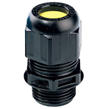
Another common misconception is that the yellow cap supplied inside our Exe glands makes the gland suitable for use as a stopping plug. This is absolutely not the case. The cap only serves as protection against dirt and dust and must be removed during installation.
In Exe applications, in practice it is almost always mandatory between a cable gland, adapter or plug and a housing.
This washer is necessary to guarantee the minimum IP54 requirement for Exe.
Only if the wall of the housing is thicker than 6 mm and it concerns a tapped hole may the washer be omitted (sealing via screw thread).
The logical rule is that cable glands and housings are made of the same material: metal cable glands should be screwed on to metal housings and plastic cable glands should be screwed on to plastic housings.
However, in practice this may lead to some problems:
- Stainless steel housings: stainless steel cable glands are very expensive.
- Aluminium housings: aluminium cable glands may gall after some time.
- Potential differences between different metals (thermocouple effect) cause corrosion.
If you fit a metal cable gland to plastic, the cable gland must be grounded.
We have the following solutions for our CP series:
- Offshore plate on the inside of the cabinet: elegant, easy solution.
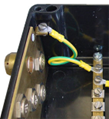
- Individual grounding plates on the outside of the cabinet: end user must apply grounding to every plate himself.

To check NPT screw thread one starts from the rules according to the NPT standard ANSI / ASME B1.20.1, old EN 50018 and new EN 60079-1.
In the case of male screw thread, the rules of the NPT standard are identical to that of the Exd standard. The working method for testing an Exd cable gland with a ring gauge is thus the same as that of standard material.
When female screw thread is involved, however, there is a difference between the NPT standard and the Exd standard EN 60079-1. The working method for testing female NPT screw thread with a plug gauge consequently requires the necessary knowledge.
Contact us if you’d like more information on this.
Theoretically it is allowed to equip Exd cable glands, adaptors or plugs with a gasket - on condition, however, that there has to be a minimum of 5 complete threads of contact. This applies for both straight (metric) and conical (NPT) wire.
Thus in practice (simply) adding your own gasket for a metric adaptor, plug or cable gland is not recommended!
The application of grease to the screw thread is allowed if it is a suitable grease, meaning: non-hardening, non-metallic and non-flammable, and as long as the earthing remains assured.
Article 13 of the current edition of EN60079-1: 2014 (Exd standard) states that only 1 adapter is allowed per hole. The same article also states that it is not permitted to install a stop in such an adapter.
"Each entry shall have no more than one thread adapter when an adapter is used. A blanking element shall not be used with an adapter."
The term adapter refers to both a reducer and enlarger (see drawing C2 in annex C).
When Exe glands (plastic or metal) are mounted in an Exe housing in combination with a locknut, this last one should be a metal one. Since the combination gland-nut should also resist the impact- and aging tests (for plastics) as described in the EN 60079-0.
This means in practice that a regular plastic locknut after a severe winter and/or a warm summer would break while undergoing this impacttest.
Of course there are suitable plastics which allow to create an 'ex-plastic-locknut'. However, certification of this product would not be useful. This is why most of the EU-type examination certificates of plastic Exe glands include the instruction, in case of the need of a locknut, to use a metal one.
Nos partenaires

Bimed Teknik